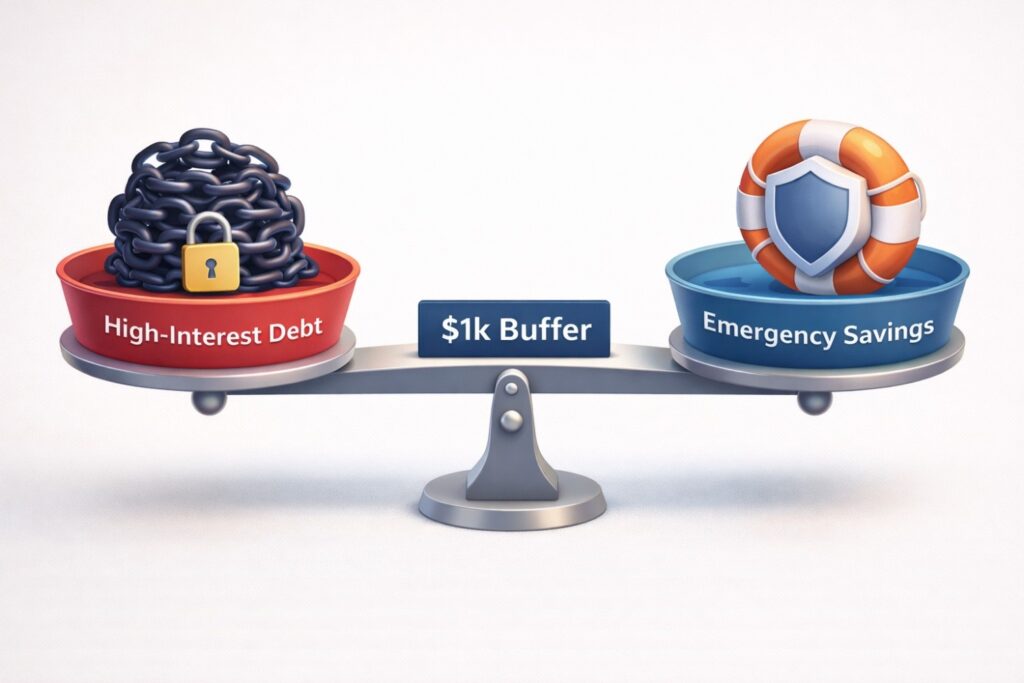
The Moment You Realize You Can’t Do Both
Save or pay off debt, that’s the question people ask when they finally have extra money left after paying bills. This question doesn’t show up when everything is falling apart. It shows up when, for once, you actually did something right. You made a budget. You paid the bills. You covered your loan payments. You even sent the minimum on your credit card without pretending you’d do it tomorrow. And suddenly… there’s money left.
Not quit your job money. Not life changing money. Just enough to create a brand new problem: what the hell am I supposed to do with this now?
And that’s where the headache starts. Save it, and you feel guilty for sitting on cash while debt quietly charges interest in the background. Throw it at the debt, and you immediately imagine your car dying, your boiler exploding, or life pulling some other expensive joke the second your balance drops too low. Invest it, and you feel smart for about five minutes, right up until the market reminds you that confidence is not a risk management strategy.
Welcome to adulthood. Properly.
Before You Decide What to Do With That Money, Make Sure It’s Actually “Extra”
This is where most people screw up without realizing it. They see money left in the account and automatically label it as progress. Except paying the minimum on a credit card is not paying off debt. It’s maintaining it.
If you’re carrying a balance at 20–25% and proudly paying the minimum, your debt isn’t going anywhere. It’s just behaving nicely for now. That “extra” cash you’re debating over may simply be money that hasn’t yet been eaten by interest.
This isn’t about guilt. Debt doesn’t always come from stupidity. Sometimes it comes from life.
Not All Debt Is the Same
But Everyone Pretends Theirs Is Special
Maybe you took a car loan because you needed a reliable vehicle for work. Or maybe you were just tired of driving something that felt like a cry for help. Doesn’t matter now. The payment still shows up every month, and the car loses value faster than your New Year’s resolutions.
Maybe you paid for a dress with a credit card. For a date. Or for work. Or for that interview that was supposed to change everything. Now you’re paying 25% interest on a piece of fabric and a memory. Elegant.
And the house? Please. Nobody sane is buying a home with cash unless they’re selling a course or living in a different century. A mortgage is structural debt. Normal. Acceptable. But still debt and it gets a vote every single time you think you have free money.
The problem isn’t that you have different kinds of debt. The problem is that once payments are automated, you stop feeling them. Minimum sent. Instalment paid. Brain off. Suddenly that leftover cash feels free, even though half your financial life is already booked for the next 10, 20, or 30 years.
Are You Actually Paying Off Debt, Or Just Keeping It Calm?
Here’s where honesty becomes uncomfortable. If your extra money isn’t meaningfully reducing your balances, you’re not getting out of debt. You’re just managing the discomfort.
Minimum payments don’t solve anything. They just keep the debt from screaming. Banks love people who pay the minimum. Calm. Predictable. Long-term sources of interest. A dream client.
And that’s exactly why this save or kill debt question exists in the first place. Somewhere deep down, you know that this being responsible phase might just be nicely packaged stagnation.
Emergency Fund
Or Why I’ll Figure It Out When It Happens Is Not a Plan
This is where people panic and say, But I need savings in case something happens. And for once, they’re not completely wrong.
If you have zero cash buffer, aggressively overpaying debt is just gambling with timing. Not heroic. Stupid. Because life has an impressive talent for breaking exactly when you least need it to.
That said, an emergency fund is not an excuse to ignore toxic debt for years. It’s protection against making things worse, not a reward for being disciplined. Enough to stop you from reaching for a credit card when something goes wrong. Nothing more.
Anything beyond that and you’re just buying comfort while the real problem stays alive.
What If I Invest Instead?
The Favourite Fantasy of People With Debt
This is the part where you try to be clever. Maybe instead of overpaying debt, you invest the money. Markets go up. Debt is cheap. You’re smarter now.
On paper? Maybe it works. In reality? It usually wrecks people psychologically.
Investing while debt sits in the background makes every market move hurt more. Drops feel terrifying. Gains feel fragile. Nothing feels stable because you’re building a future while dragging unfinished business behind you.
If market volatility ruins your sleep, you’re not ready to invest. That’s not an insult. That’s just reality.
So What Do You Do With The Damn Money?
Here’s the truth nobody wants to hear: you can’t do everything at once if the surplus is small. And if you’re reading this, it probably is. If you’re carrying high interest consumer debt, that’s the thing that dies first. No debates. No spreadsheets. No ego.
If you have zero cash buffer, you need a small one even if debt annoys you or you’ll just end up adding more the moment life misbehaves. Only when debt is tolerable, cash flow is stable, and the surplus is real does investing become a decision instead of a fantasy.
Final Bloody Truth
Asking this question doesn’t mean you’re good with money. It means you finally stopped pretending everything would magically fix itself. This isn’t about choosing perfectly. It’s about stopping the polite, sensible looking moves that don’t actually change anything. Your money doesn’t need balance. It needs direction. And you need the balls to admit which problem in your financial life deserves to be dealt with first. Everything else is just a well formatted excuse.
Keep reading, keep growing. BloodyFinance.